Few sculptures demonstrate the importance of genius loci more clearly than David in Florence.
The original statue today stands inside the Galleria dell’Accademia, protected, isolated, and illuminated as a museum masterpiece. There, one studies the perfection of the marble, the anatomical precision, the extraordinary technical achievement. The sculpture becomes an object of contemplation.
Yet the replica standing on the Piazza della Signoria often produces a strangely stronger urban and emotional effect — despite being ‚only‘ a copy. The reason lies in place.
In the square, the figure regains its original civic dimension. It stands within the spatial and political theater for which it was conceived: surrounded by palazzi, exposed to weather and changing light, embedded in the dense historical atmosphere of Florence. The sculpture no longer appears as an isolated art object but as part of an urban organism. The city itself completes the work.
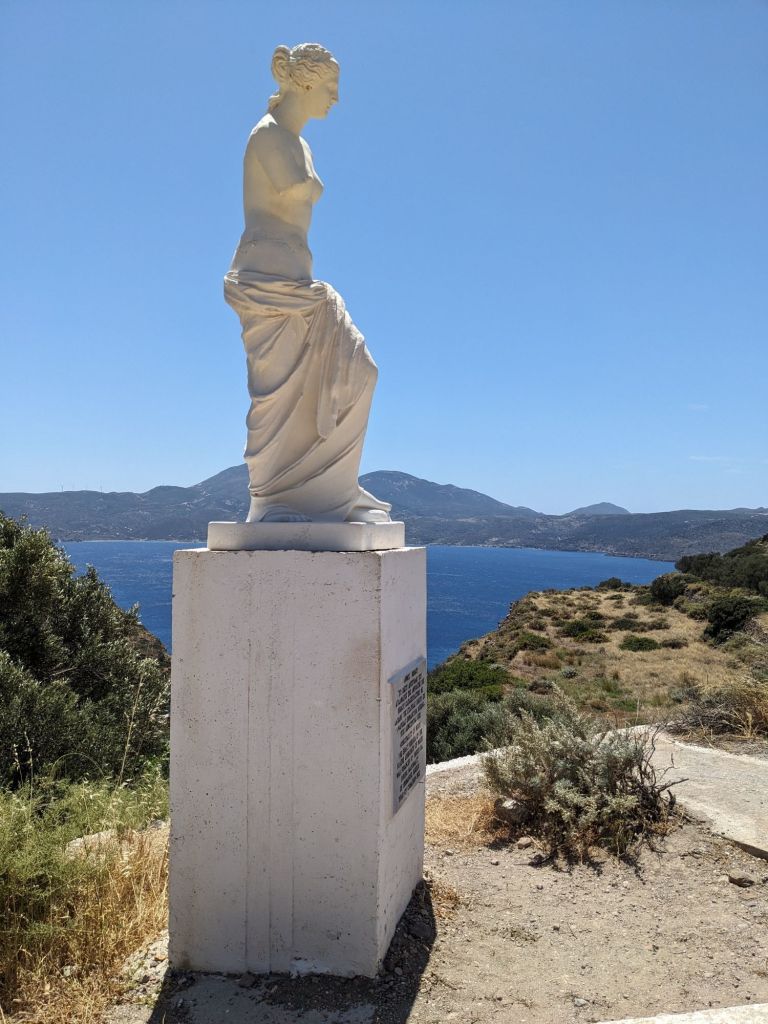
A similar phenomenon surrounds the Venus de Milo. In the Louvre Museum, the statue is elevated into a universal icon of art history. But on Milos, where landscape, sea, wind, stone, and light still resonate with the sculpture’s origin, one senses a different kind of presence — less museological, more civilizational.
These works remind us that sculpture is never entirely autonomous. Its meaning is shaped not only by form, but by context, atmosphere, geography, and collective memory. Sometimes a replica in the right place can reveal more about a work than the original in the neutrality of the museum.