The Stuttgart City Library is one of those buildings that demands to be taken seriously. Not because it overwhelms the city by scale or gesture—on the contrary—but because it insists on clarity, discipline, and restraint in an urban environment that rarely rewards such qualities. More than a decade after its completion, the building has matured into a civic presence whose architectural ambition deserves a sober, differentiated assessment.
At first encounter, the building’s cubic exterior establishes an unmistakable order: introverted, abstract, almost mute. Yet this silence is intentional. It prepares the visitor for a carefully staged interior sequence in which architecture is not spectacle but structure, light, and spatial logic.
The Upper Library: A Convincing Civic Interior
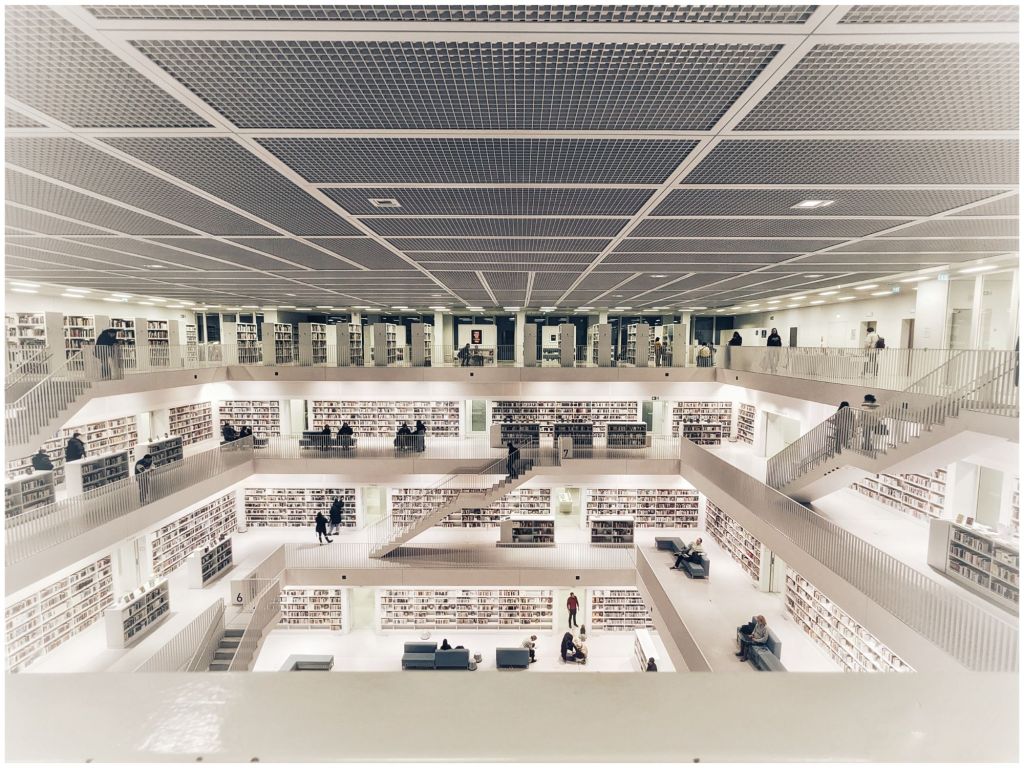
The true strength of the Stuttgart City Library unfolds above. The ascent into the upper levels—where the open-access library unfolds as a vertically layered, unified spatial volume—is remarkably successful. Here, shelves, galleries, and circulation are absorbed into a single architectural idea: a large, calm room expanding upward, governed by proportion rather than ornament.
This spatial conception unmistakably evokes the legacy of Étienne-Louis Boullée—not in literal form, but in spirit. Like Boullée’s visionary library designs, the Stuttgart library understands knowledge as something that requires space, not just storage: a legible order, a sense of gravity, and above all, light as an architectural principle. The upper library achieves precisely this. It is monumental without being oppressive, abstract without being cold. Its success lies in restraint.
Material Precision and Constructive Care
Equally convincing is the execution. Few recent public buildings in Germany display such consistency in constructive detailing: joints, reveals, transitions, and technical integrations are handled with exemplary care. The material palette—dominated by carefully calibrated whites and grays—supports the architecture’s conceptual clarity rather than distracting from it. Even the building’s technical infrastructure is subsumed into the architectural order, reinforcing the impression of a meticulously composed whole.
This attention to detail gives the building durability beyond architectural fashion. It is a crafted civic structure, not an image.
The Lower Void: An Unresolved Question

Yet for all these strengths, a critical tension remains—one that cannot be ignored. The large void in the lower levels, centered around a monumental, opaque core culminating in a roof element often described as an “oculus,” remains difficult to justify in its spatial and symbolic role.
Unlike the upper library, this lower void lacks programmatic clarity. Its emptiness feels less like intentional monumentality and more like suspended meaning. While faint analogies may be drawn to the great reading room of the Badische Landesbibliothek Karlsruhe by Ungers—particularly in the idea of a vertical spatial reference—these connections remain weak and largely symbolic. Where Karlsruhe’s reading room anchors intellectual concentration, Stuttgart’s lower void seems to hover in a state of abstraction without a clear architectural necessity.
The ’skylight‘, rising into the upper gallery space like a stone sarcophagus, exacerbates this ambiguity. Rather than mediating between light and depth in a Boullée-like sense, it appears introverted, heavy, almost resistant to interpretation. It is here that the building’s otherwise disciplined architectural logic falters.
A Library Worth Defending—With Reservations
And yet: these unresolved aspects do not negate the building’s achievement. The Stuttgart City Library is, as a whole, a serious piece of civic architecture—one that resists populism, spectacle, and easy symbolism. Its best spaces succeed precisely because they trust architectural fundamentals: proportion, light, order, and constructive clarity.
If Boullée’s shadow lingers here, it does so not as a flawless ideal, but as a reminder of architecture’s enduring challenge: not every monumental void automatically carries meaning. Where the Stuttgart library succeeds, it does so by grounding abstraction in use and spatial experience. Where it struggles, it reveals how fragile architectural symbolism can be when detached from programmatic necessity.
That tension, however, may ultimately be productive. It forces us to read the building attentively—neither celebrating it uncritically nor dismissing it superficially. As such, the Stuttgart City Library deserves something rare in contemporary architectural discourse: sustained, thoughtful engagement.
 Luigi Monzo