
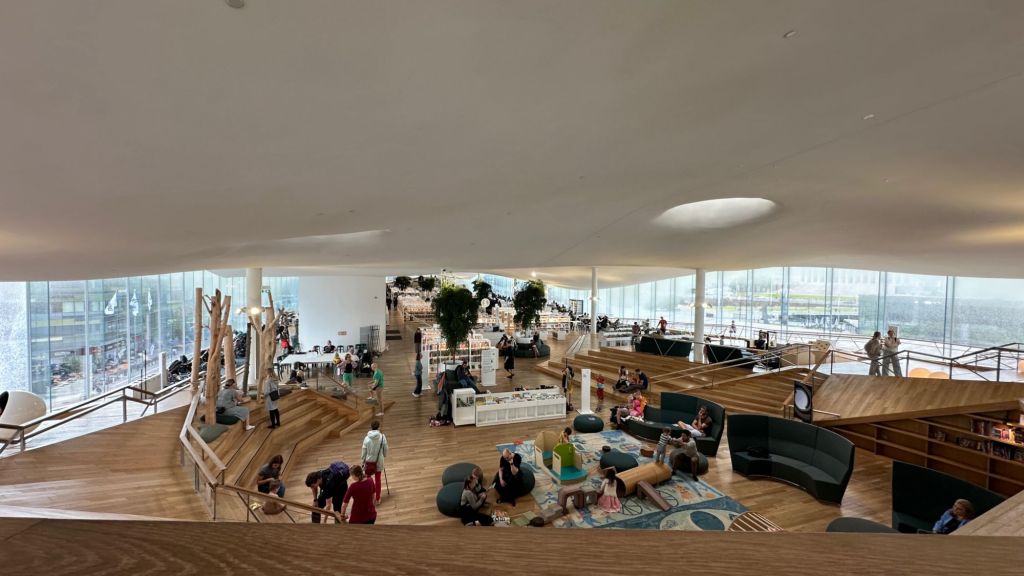
Helsinki’s Central Library Oodi is frequently described as a “living room for the city.” The phrase may sound casual, but it captures a precise architectural stance—one that becomes especially legible when read against the Stadtbibliothek Stuttgart. Where Stuttgart insists on architectural clarity and abstraction, Oodi pursues civic continuity, ease, and spatial generosity as its primary virtues. The difference is not one of quality, but of conviction.
Stuttgart’s library presents itself as an object: a cube of controlled geometry and intellectual distance. Its architecture is didactic, almost pedagogical. One enters a sequence that is carefully staged, inward-looking, and conceptually closed. Oodi, by contrast, resists objecthood. It behaves less like a monument and more like an inhabited urban interior—porous at ground level, expansive above, and deliberately informal in tone.
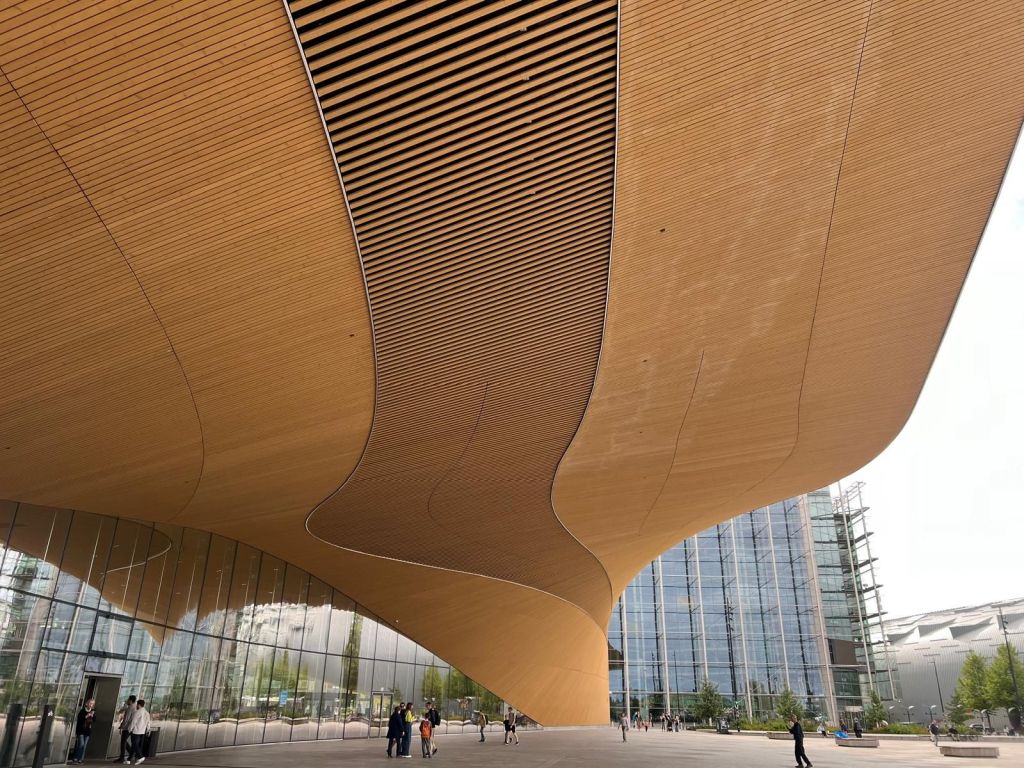
This difference already becomes evident at the point of entry. Oodi does not demand architectural reverence. The ground floor absorbs the city almost without threshold, functioning as an interior extension of Helsinki’s civic realm. Movement, noise, informality, and everyday occupation are not merely tolerated but spatially anticipated. The building does not ask the visitor to adapt to architecture; it adapts architecture to the visitor.
The upper reading level offers a productive parallel to Stuttgart. Both buildings reserve their strongest spatial moment for the Freihandbereiche above: a large, unified reading landscape that rewards ascent. Yet the atmosphere could hardly be more different. Stuttgart’s reading space feels inward, white, almost metaphysical—an interior disciplined to silence and visual control. Oodi’s so-called “book heaven” is outward-facing, daylit, and intentionally relaxed. Knowledge here is not staged as solemn achievement but as shared, everyday presence. The city remains visible; reading is embedded in life, not withdrawn from it.
The most telling contrast, however, lies in the handling of section and emptiness. Stuttgart’s vast lower void is a powerful architectural gesture, but one whose functional justification remains open to question. Its meaning is symbolic rather than instrumental. Oodi solves the same sectional challenge differently. Instead of emptiness, it embraces thickness: stacked civic worlds with clearly articulated purposes. The middle levels—workshops, studios, support spaces—transform what could have been residual volume into active infrastructure. Nothing here needs to justify itself symbolically; use is its own legitimacy.
Materially and atmospherically, the difference is equally pronounced. Stuttgart’s architecture is exacting, ascetic, and precise. Its details speak the language of discipline and control. Oodi, by contrast, cultivates warmth without sentimentality. Curved surfaces, tactile materials, and acoustic softness communicate openness and hospitality. The message is unmistakable: you may stay, linger, occupy, return.
Seen through a classical lens—one might invoke Boullée here—the two buildings position themselves at opposite ends of the same historical arc. Stuttgart knowingly tests the endurance of the sublime interior: the library as architectural idea. Oodi represents a post-sublime condition. Its ambition is not awe, but normality—making democratic access to knowledge spatially effortless and socially unmarked.
In that sense, Oodi is not a lesser library, nor a diluted one. It is simply committed to a different architectural ethic. Where Stuttgart persuades through form and abstraction, Oodi persuades through civic performance. One is an argument; the other is an invitation.
And perhaps this is the most instructive lesson of their comparison: Stuttgart asks whether the library can still function as an architectural absolute. Helsinki answers by demonstrating how convincingly the library can operate as an architectural commons.
 Luigi Monzo